Guide: How to follow African football draws without confusion
African football competitions become more interesting when teams discover their opponents in the group stage. However, for many supporters, understanding the draw, group arrangements and match schedules can be confusing. Knowing how CAF draw works makes it easier to follow the competition, identify important fixtures and understand what comes next.
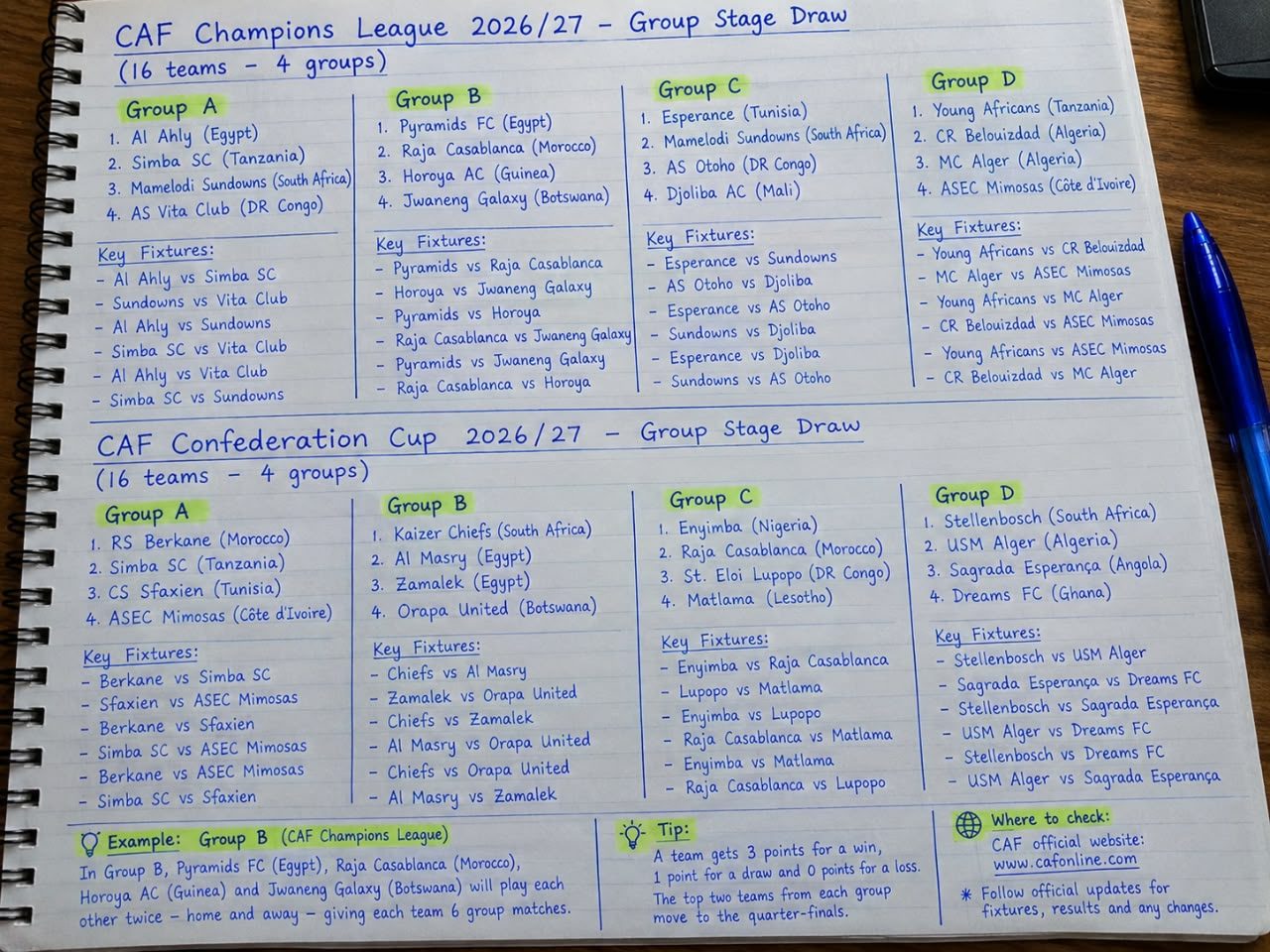
The Confederation of African Football (CAF) recently conducted the 2026/27 group-stage draws for the CAF Champions League and CAF Confederation Cup in Cairo, Egypt. These draws determined which clubs will compete against one another as the continental competitions move into their next phase.
Here is a simple guide to understanding the process and following the matches.
What a Group-Stage Draw Means
A group-stage draw is the process through which participating teams are assigned to different groups. Instead of immediately playing a knockout match, teams first compete against other clubs placed in the same group.
For the 2026/27 CAF Champions League, 16 qualified clubs were divided into four groups, with four teams in each group. The same four-group arrangement applies to the CAF Confederation Cup.
The purpose is to establish the opponents each team must face before the knockout stage begins.
For example, in the CAF Champions League 2026/27, Group B contains Zamalek of Egypt, MC Alger of Algeria, Young Africans of Tanzania and Club Africain of Tunisia.
This means these four clubs will compete against one another during the group stage. Supporters can immediately identify the teams in the group without having to search through the entire competition.
How to Read Groups and Fixtures
Understanding group arrangements becomes easier when you know what the information represents.
First, look at the group letters. CAF divides participating clubs into groups such as Group A, Group B, Group C and Group D. Each group contains four teams.
Second, identify the clubs listed under each group. These are the teams that will compete against one another during that stage.
Third, understand how the fixtures work. Each team plays the other three teams twice: once at home and once away. Therefore, every club has six group-stage matches.
For example, consider Group B, which contains Zamalek, MC Alger, Young Africans and Club Africain.
Zamalek will play against MC Alger, Young Africans and Club Africain. It will face each opponent twice, giving the Egyptian club six matches in total.
The same arrangement applies to the other three teams.
It is also important to understand the points system. A team receives three points for winning a match, one point for drawing and no points for losing.
These points determine the group's standings. At the end of the group stage, the top two teams from each group advance to the quarter-finals of the CAF Champions League.
This is why every fixture matters. A victory can improve a team's position, while dropped points can make qualification more difficult.
Where to Find Official Updates Fast
The most reliable place to follow African football fixtures and competition announcements is the official CAF website.
CAF publishes information about group draws, match schedules, competition regulations, results and other important developments.
Supporters can visit the official website at www.cafonline.com and navigate to the relevant competition section.
The website also provides official announcements about the Champions League and Confederation Cup. These updates help readers distinguish confirmed information from rumours or unofficial fixture lists circulating on social media.
CAF's official digital platforms, including CAF TV, also provide coverage of important competition events.
For the 2026/27 interclub competitions, the group stage is scheduled to begin on 27–29 November 2026. The remaining matchdays are scheduled for December 2026 and January 2027, with the final group-stage round taking place on 22–24 January 2027.
Checking official announcements regularly is useful because supporters can stay informed about confirmed dates, results and any subsequent changes.
What Happens After the Group Stage?
The group stage is not the final stage of the competition. It determines which clubs progress to the knockout rounds.
In the CAF Champions League, the top two teams from each of the four groups qualify for the quarter-finals. This produces eight qualifying clubs.
The knockout stage introduces a different challenge because teams must progress through successive rounds to reach the final.
Consequently, following the group standings is just as important as following individual matches. A club might lose one fixture but remain in a strong position if it has collected enough points from its other games.
A Simple Way to Follow African Football Fixtures
You do not need to understand every competition regulation to follow African club football.
Start by identifying your preferred competition, checking the four groups and noting the opponents of the team you support. Then follow the official fixture announcements and check the standings after each matchday.
Understanding group arrangements, points and qualification requirements will make the competition easier to follow.
With the 2026/27 CAF Champions League and Confederation Cup draws now completed, supporters can begin preparing for the upcoming fixtures and the exciting contests ahead.
Sources
- www.cafonline.com/caf-champions-league/news/zamalek-mc-alger-and-tunisian-rivals-collide-as-totalenergies-caf-champions-league-group-stage-draw-delivers-blockbuster-clashes/
- www.cafonline.com/caf-confederation-cup/news/totalenergies-caf-confederation-cup-202627-group-stage-draw-produces-exciting-encounters/
Version 1.0. Kobo Daily stories are edited before publication and updated as facts change. Spotted an error? Tell our editors.