Tesla’s ‘Flying’ Roadster Raises Questions About Road Safety and Government Regulation.
Tesla’s ‘Flying’ Roadster Raises Questions About Road Safety and Government Regulation
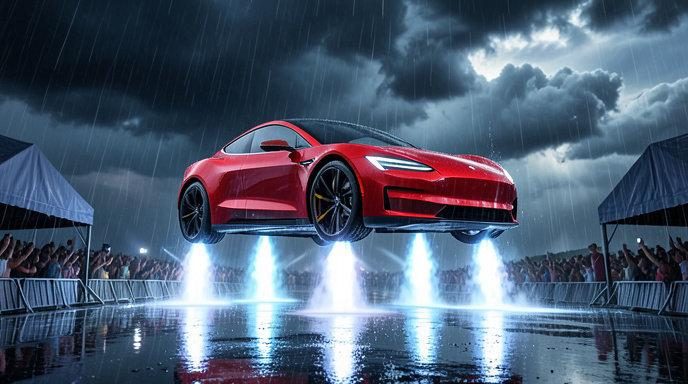
Tesla’s latest Roadster has sparked fresh discussion about the future of transportation after its October 2026 unveiling featured a demonstration of the electric sports car lifting into the air using rocket-style thrusters.
The vehicle, unveiled by Tesla chief executive Elon Musk, has attracted attention for its unusual engineering and the possibility of combining road travel with limited flight capabilities. However, the demonstration has also raised questions about public safety, government regulation and whether flying vehicles could eventually become part of everyday transport.
For ordinary road users, the bigger question is not simply whether a car can leave the ground. It is how authorities would protect pedestrians, motorists and other members of the public if vehicles capable of airborne movement were allowed near public roads.
Is the Tesla Roadster really a flying car?
Tesla presented the new Roadster as a high-performance electric sports car developed in collaboration with SpaceX engineers.
During the unveiling, the vehicle demonstrated the use of a suction system and cold-gas thrusters to perform unusual movements, including lifting and rotating in the air.
Tesla’s website describes different versions of the vehicle. Its Rocket configuration is advertised as having a full flight system, while the company states that this version is not approved for public road use.
This distinction is important because the demonstration does not establish that the vehicle can operate like an aircraft, fly long distances or safely travel above ordinary traffic.
The company has also indicated that production is expected in 2028, meaning the technology is not yet an everyday transport option.
Could flying vehicles make roads safer?
The idea of flying cars is often presented as a possible solution to traffic congestion. If vehicles could travel above crowded roads, some journeys might eventually become faster and reduce pressure on existing transport networks.
However, flying vehicles would introduce safety concerns that conventional cars do not face.
A vehicle that leaves the ground must account for airspace restrictions, weather conditions, emergency landing locations, mechanical failures and the risk of falling or colliding with other objects.
In a busy city, these concerns become even more serious. Buildings, power lines, pedestrians, road traffic and other aircraft would all need to be considered.
A vehicle that performs well in a controlled demonstration is not automatically safe for everyday use.
What role would governments play?
Governments and transport regulators would have to establish clear rules before flying vehicles could operate in public spaces.
In the United States, the National Highway Traffic Safety Administration oversees motor vehicle safety, while the Federal Aviation Administration regulates civil aviation.
However, the division of responsibility becomes more complicated when a vehicle is designed to operate both on roads and in the air.
Following Tesla’s unveiling, the FAA said the vehicle did not meet its definition of an aircraft, according to CBS News. The Roadster’s unusual design therefore raises questions about which regulatory framework would apply to its different operating modes.
Authorities would need to consider whether separate approvals should be required for road operation and flight, as well as rules covering pilot qualifications, insurance, maintenance, airspace access and emergency procedures.
Without clear standards, allowing such vehicles into public environments could create risks for people who have no control over their operation.
What about ordinary road users?
While the Roadster is positioned as a high-end sports car, its wider significance goes beyond the people who may be able to afford it.
Most motorists are unlikely to purchase such an expensive vehicle. However, pedestrians, cyclists, public transport users and ordinary drivers could still be affected by the introduction of new transport technologies.
If flying vehicles eventually become commercially available, governments would need to ensure that public safety does not depend on whether someone owns an advanced vehicle.
The cost of emergency services, road infrastructure, air traffic management and public safety enforcement would also need to be considered.
For many people, the immediate priorities remain safer roads, reliable public transport, affordable mobility and better traffic management.
A technology that still needs answers
Tesla’s Roadster demonstration has renewed interest in the possibility of vehicles that can move between road and airborne travel.
However, there is a significant difference between demonstrating a technological capability and proving that it can work safely and reliably in everyday conditions.
Production, regulatory approval and practical operating requirements remain important hurdles.
For now, the Roadster should be viewed as an experimental step in high-performance vehicle engineering rather than proof that flying cars are ready to replace conventional transport.
The challenge for governments will be to encourage innovation without allowing public safety to become an afterthought.
As the technology develops, the most important measure of success will not simply be how high or how fast a vehicle can fly, but whether it can operate without putting other road users at risk.
Version 1.0. Kobo Daily stories are edited before publication and updated as facts change. Spotted an error? Tell our editors.